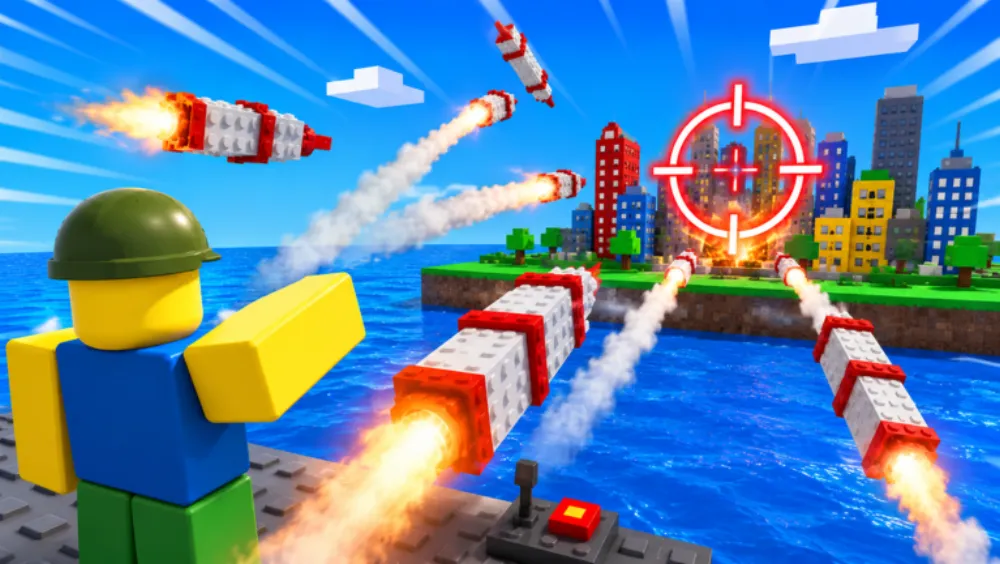
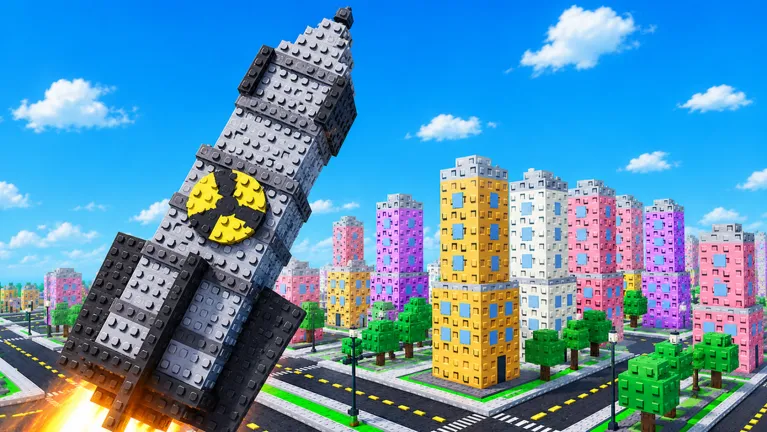
Missiles vs Cities is a Roblox city-building tycoon developed by veedio gaems, released on 31 May 2026. In just over five weeks it has pulled 604,000+ visits and is currently holding 5,600+ concurrent players, a strong early signal for a game that launched in a crowded missile-tycoon category. The premise is direct: build a city from scratch, grow its output, arm yourself with increasingly destructive missiles, and blow up rival players’ buildings to collect cash and rewards.
What Is Missiles vs Cities?
Missiles vs Cities is a Simulation / Tycoon game on Roblox developed by the group veedio gaems. The gameplay blends city-building with live PvP missile combat: you construct and upgrade an urban area on your plot, then use that city’s output to fund a missile arsenal aimed at your opponents.
What distinguishes Missiles vs Cities from similar games in the genre is the explicit rewards loop. Destroying another player’s buildings does not just deny them infrastructure, it earns you cash and rewards that feed directly back into your own city. Every missile you fire is both an attack on your rival and an investment in your own growth. The game runs 8 players per server, one step larger than the 6-player format used by comparable titles like Nuke Wars and Missile Wars.
Quick stats (as of early July 2026):
- Visits: 604,000+
- Favourites: 5,860
- Concurrent players: 5,600+
- Server size: 8 players
- Created: 31 May 2026
- Last updated: 7 July 2026 (active development)
- Developer: veedio gaems (Group)
- Genre: Simulation / Tycoon
- Platforms: PC, mobile, console
- Free to play
The Core Loop
Missiles vs Cities runs a tightly connected three-phase loop that the developer’s description captures plainly: build up your city, arm yourself with the best missiles, blow up others’ buildings for cash and rewards.
Build phase. Your city starts small. Early decisions revolve around placing and upgrading structures that generate income. A stronger city generates income faster, which means a faster path to better missiles and more robust upgrades. Spending the first minutes maximising city output rather than rushing into combat is almost always the correct opening approach.
Arm phase. Once your city is generating steady income, missile acquisition becomes the focus. Missiles vary in power, the game explicitly rewards players for seeking out “the best missiles”, so unlocking higher-tier weapons ahead of opponents gives a meaningful combat advantage.
Cash-and-rewards phase. Landing missiles on rival buildings pays out cash and rewards, not just damage. This creates an active incentive to attack throughout the match, not only when you have a decisive advantage. Players who let the cash loop run, fire regularly, collect rewards, reinvest, outpace those who stockpile and then launch a single large offensive.
Building and Upgrading Your City
Your city is both your economic engine and your primary target on the map. Every building destroyed by a rival is income and production capacity removed from your operation. This makes city construction a dual-purpose exercise: build for output and build for resilience.
The 8-player server format in Missiles vs Cities adds more simultaneous pressure than the 6-player format common in similar games. With eight active players all building and firing in the same session, incoming fire can arrive quickly and from multiple directions. Spreading your city to reduce the blast impact of incoming strikes, rather than clustering everything in one spot, is a defensive consideration that becomes relevant once the mid-game missile exchanges start.
Upgrades compound over time. A building upgraded to higher tiers generates meaningfully more output than the same building at base level. The correct investment sequence in most rounds is to upgrade existing structures before building new ones at low tiers, the multiplier effect on established buildings is more efficient than spreading investment thin across new construction.
Missile Attacks and the Rewards System
The rewards loop is the feature that makes Missiles vs Cities feel different from straightforward war tycoons. When you destroy an opponent’s building, the game pays out. That payout funds more city development and better missiles, so the mid-game becomes a feedback loop where the most aggressive player accumulates the most resources, provided their own city stays alive long enough to collect.
With 8 players in a server, the political layer matters. Players who spend the opening phase targeting the same opponent can remove them quickly, redistributing their share of server attention. The player who avoids incoming fire longest while still collecting rewards from attacks tends to reach the late game in the strongest position.
Tips for New Players
Build before you attack. The temptation is to fire missiles immediately, but the cash-and-rewards loop pays more when you have a stronger city generating income to reinvest. Spend the first two to three minutes on city construction and upgrades before switching attention to offense.
Upgrade before expanding. Higher-tier upgrades on existing structures out-produce adding new structures at base level. Concentrate upgrades before adding new build slots.
Attack regularly, not just when you’re ready. The rewards payout from hitting rival buildings is continuous, landing hits regularly, even with early-tier missiles, keeps cash flowing into your city while denying opponents uninterrupted building time.
Stay aware of incoming fire. With 8 players active and an explicit cash incentive to attack, incoming missiles arrive more frequently in Missiles vs Cities than in smaller-server alternatives. Don’t neglect defensive city layout in favour of pure offense.
The late game favours accumulated rewards. Players who maintained a consistent attack pace throughout the round enter the late game with more resources. Catching up from a passive early game is difficult once opponents have compounded their cash advantage.
How to Play Missiles vs Cities on Roblox
Missiles vs Cities is free to play on Roblox across PC, mobile (iOS/Android), and console:
- Direct link: Roblox. Missiles vs Cities (place ID 112641748896693)
- In-app search: search “Missiles vs Cities” on Roblox
- Developer: veedio gaems (Group)
- No Robux required for core gameplay
FAQ
Does Missiles vs Cities have codes? No codes have been announced by veedio gaems as of early July 2026. Tycoon and city-building games on Roblox typically do not use promo code systems, rewards come from in-game destruction and cash payouts rather than developer-distributed codes. Check this page for updates if a code system is added in a future update.
How many players are in a Missiles vs Cities server? Each server holds up to 8 players. This is slightly larger than the 6-player format used by Missile Wars and Nuke Wars, which means more simultaneous targets and more incoming fire in each match.
Who made Missiles vs Cities? Missiles vs Cities was developed by veedio gaems, a Roblox group. The game launched on 31 May 2026 and received an update on 7 July 2026, suggesting active ongoing development.
Is Missiles vs Cities the same as Missile Wars? No. Missiles vs Cities (by veedio gaems) and Missile Wars Roblox (by STRAY DYNAMICS) are separate games. Both combine city or base-building with missile PvP, but have different developer teams, different reward structures, and different server sizes (8 vs 6 players). If you enjoy one, the other is worth trying for the same core loop with different pacing.
Other Roblox missile and city-destruction games worth checking out? For a 6-player missile PvP tycoon with a similar economy-build loop, Missile Wars Roblox is the closest comparison. Nuke Wars Roblox by Okay HB runs the same city-economy-then-destroy format with 4.6M+ visits. Both are recommended for players who enjoy Missiles vs Cities and want to compare the genre variants.
![[CURSED] Anime Astral Simulator Tier List cover](/article-covers/anime-astral-simulator-tier-list.webp)